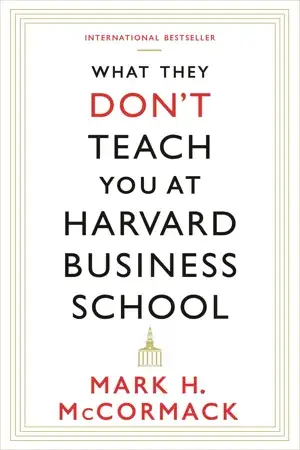
Don’t Teach You at Harvard Business School
Book Link is Given Below:
When it comes to business education, Harvard Business School (HBS) is often seen as the ultimate destination. Students from around the world flock there to learn the latest strategies, frameworks, and case studies from top professors. Yet, Don’t Teach You at Harvard Business School reminds us that real-world business success often requires skills and insights that no classroom can fully provide. This book sheds light on the lessons that go beyond textbooks, teaching readers how to navigate the complex, unpredictable, and often challenging world of business.
Overview of Don’t Teach You at Harvard Business School
Don’t Teach You at Harvard Business School offers a candid look at the practical knowledge, personal strategies, and mindset shifts that successful business leaders rely on every day. While HBS teaches the theory, financial models, and case studies, this book focuses on actionable lessons that are usually learned through experience. It bridges the gap between academic knowledge and real-world application, showing readers what it truly takes to thrive in business.
The book covers a variety of topics, from entrepreneurship and leadership to negotiation, decision-making, and risk management. By emphasizing practical examples, personal anecdotes, and actionable strategies, Don’t Teach You at Harvard Business School becomes a roadmap for those looking to achieve tangible results in their careers.
Core Lessons from the Book
- Real-World Decision Making: Unlike academic exercises, real-world business decisions often involve uncertainty, incomplete information, and competing interests. Don’t Teach You at Harvard Business School highlights how successful leaders approach these situations with strategic thinking and adaptability.
- Entrepreneurial Mindset: While HBS provides tools for business analysis, this book emphasizes creativity, innovation, and the willingness to take calculated risks. Aspiring entrepreneurs learn that failure is part of the process and that resilience often separates success from stagnation.
- Leadership Beyond Authority: Leadership is not just about titles or organizational charts. Don’t Teach You at Harvard Business School explains how to influence teams, inspire trust, and foster collaboration—even when formal authority is limited.
- Negotiation and Influence: Negotiating in the real world requires more than textbook tactics. The book teaches readers to read people, anticipate reactions, and craft win-win solutions in complex business dealings.
- Emotional Intelligence and Soft Skills: Academic programs often focus on analytical skills, but real-world success depends on understanding human behavior, managing emotions, and building lasting relationships. Don’t Teach You at Harvard Business School provides guidance on developing these essential soft skills.
Why This Book is Important
Many professionals believe that prestigious degrees automatically translate into business success. However, Don’t Teach You at Harvard Business School reminds us that while education is valuable, it cannot replace hands-on experience and practical wisdom. Business challenges are rarely predictable, and success often depends on intuition, people skills, and the ability to adapt quickly.
The book also serves as a reality check for students and professionals who may over-rely on theory. By sharing insights from seasoned leaders, entrepreneurs, and executives, it teaches readers how to bridge the gap between knowledge and execution.
Who Should Read Don’t Teach You at Harvard Business School
- Aspiring Entrepreneurs: Learn how to navigate uncertainty, identify opportunities, and make bold decisions that drive growth.
- Business Professionals: Gain insights into leadership, negotiation, and organizational influence beyond textbook strategies.
- Students of Business: Complement formal education with practical skills that are often overlooked in academic programs.
- Career Changers: Understand how to adapt skills to new industries and roles by focusing on real-world problem-solving.
By reading Don’t Teach You at Harvard Business School, individuals from diverse backgrounds can gain lessons that accelerate their professional growth and help them make informed, impactful decisions.
Practical Applications
The strategies and lessons outlined in Don’t Teach You at Harvard Business School can be applied immediately. Readers can use them to:
- Improve leadership effectiveness by focusing on influence and collaboration rather than formal authority.
- Approach problem-solving with flexibility, creativity, and practical judgment.
- Negotiate more effectively by understanding human behavior and anticipating outcomes.
- Make smarter business decisions under uncertainty by learning from real-world examples.
- Develop emotional intelligence to strengthen professional relationships and workplace culture.
By integrating these lessons into daily practice, readers enhance their ability to succeed in environments where textbooks and case studies may fall short.
Conclusion
Don’t Teach You at Harvard Business School is an essential read for anyone seeking to complement formal business education with practical wisdom. It emphasizes the lessons that real-world experience teaches, from leadership and negotiation to resilience and emotional intelligence. The book reminds us that while academic credentials are valuable, success in business requires skills, mindset, and judgment that go beyond the classroom.
For professionals, entrepreneurs, and students alike, Don’t Teach You at Harvard Business School provides actionable insights and a roadmap for navigating the complexities of modern business. It is a valuable resource for anyone committed to continuous learning, personal growth, and achieving real-world results.
Disclaimer: The content of this article is provided for educational and informational purposes only. PDF resources of Don’t Teach You at Harvard Business School are intended for personal and educational use. All copyrights and intellectual property rights belong to their respective owners. No copyrighted material is distributed for commercial purposes via this website.
Comments (0)